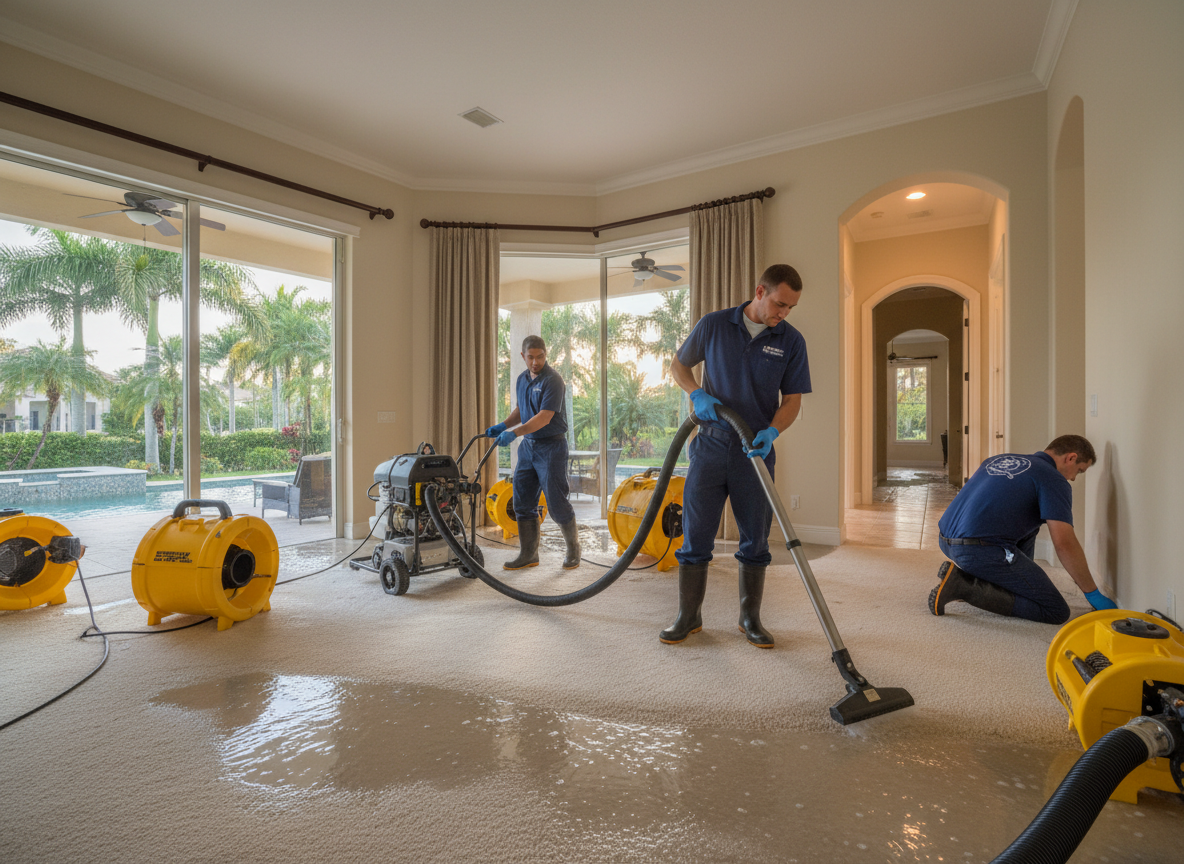
Standing water looks like the whole problem and is only the first part of it. Under the carpet, behind the baseboard and inside the cabinet base, the water has already started to spread. Water extraction in Boca Raton is the work of pulling water out of those places before the visible puddle is gone and the real damage begins. It is a separate service here because it is often the only thing a homeowner needs after a small, clean supply-line break.
Why a water extraction call is different from a drying job
Extraction and drying are usually described as one service. They are not the same task, and treating them as one is how a room ends up smelling a week after it looked dry.
Extraction is mechanical. Water has to be lifted, pulled or vacuumed out of the material. A pump removes what is standing on the floor; a weighted extraction head pulls water out of carpet and pad; hand tools reach the wall base and the cabinet toe kick. No amount of air movement removes a puddle.
Drying is thermodynamic. Once the bulk water is gone, the job is to move moisture out of the assembly faster than it can spread. Air movers, dehumidifiers and, where needed, cavity drying do that work. Starting drying before extraction is finished just moves wet air around.
The boundary decides the equipment. A small spill in one room needs a different set-up from water that has travelled under a tile floor into two wall bases. We read before we place equipment, because the wrong set-up dries the air and leaves the wall wet.
The record protects the scope. Photographs of the water line, the readings before and after extraction, and a note of what was removed make the job auditable. That matters in a rental, a condo or a building where more than one person owns the assembly.
Why standing water in Boca Raton gets into the structure so fast
Boca Raton sits on sandy coastal ground with a high water table, and the construction here reflects it: slab-on-grade, tile and thinset, cabinet bases close to the floor, and wall assemblies that were never designed to drain. Water on a slab has nowhere to go but sideways. It travels under tile through the thinset, into the base of the drywall, and along the bottom plate of the wall.
The climate does the rest. A closed house with the air conditioning running is cool and humid, and wet material in that environment does not dry quickly on its own. In the first day, water wicks into the paper facing of drywall and the core of engineered wood. By the second or third day, the smell arrives. Extraction on the first day is a different job from extraction on the fourth.
Hurricane season adds a second source. From 1 June to 30 November, rain can arrive faster than the ground and the canal system can take it. The barrier island and the low streets near the Intracoastal can hold water against a wall base for hours after the rain stops, and that water enters the same assembly a supply-line leak would. The source changes the water category and the cleaning, not the urgency.
In the western communities, the problem is flat ground and retention lakes. Water that cannot drain away sits against foundations and pool decks, and a small interior leak at the same time turns a manageable drying job into a larger one.
What you can check before you book water extraction
Boca Raton FL Mold Remediation is at 5461 N Dixie Hwy, Boca Raton, FL 33487, in Palm Beach County, and the number is (561) 960-0937. The services are exactly four: mold remediation, water damage repair, water extraction and storm damage restoration. Water extraction is also a named phase inside water damage repair, which is why both pages exist.
The area is Boca Raton and eight towns within about nine miles: Highland Beach, Delray Beach, Boca Del Mar, Deerfield Beach, Whisper Walk, Sandalfoot Cove, Mission Bay and Lighthouse Point. Two are in Broward County and six are in Palm Beach County.
We do not publish a licence number, certifications, insurance, a founding year, staff biographies, project counts or reviews, because the business has not supplied those facts. We do not claim a response time, and we do not quote a price before the building has been read. What we can tell you on the call is what the visit involves and what would make it unnecessary.
A ground-floor unit on the Boca Raton barrier island
About one square mile of Boca Raton lies on Deerfield Beach Island, the barrier strip east of the Intracoastal, alongside the beach and the inlet. Much of that housing is multi-storey, and the ground floor is where a water loss behaves differently from a house on the mainland.
A supply line fails in a ground-floor unit, or a water heater in a closet lets go overnight. The water spreads across the tile, reaches the base of the wall and runs into the corridor or the neighbouring unit before anyone notices. By morning there is a wet carpet in one room, a damp corridor and a complaint from two doors down.
The first difference is the slab. There is no crawlspace and no void under the floor, so water that gets under the tile has nowhere to drain. It sits in the thinset and the fill, and the tile can look dry while the assembly underneath is still wet. Extraction has to include the floor edges and the wall base, not just the visible room.
The second is the shared building. The corridor, the elevator lobby and the unit below may all be affected, and the association controls access and the route material leaves by. We document the unit boundary, protect the common areas and bag material out rather than carrying wet carpet through a lobby. If the repair touches common property, the association's contractor may own that part, and we say so in the scope.
The third is timing. A seasonal owner may not be in the unit when the leak happens, and the water can sit for weeks. A musty smell at the door is often the first sign. In that situation extraction is only the start; the wall base and the cabinet bases have to be read before anyone decides what can be saved.
Where water hides after the pump stops
A floor that looks dry is not a dry room. These are the four places water stays after the visible puddle is gone, and each one needs a different extraction method.
Carpet, pad and the tack strip
The component is the carpet face, the pad underneath, the tack strip along the wall and the gripper nails that hold it. Carpet can look dry on top while the pad is saturated, and the tack strip holds water against the wall base. What you notice is a damp smell at the edge of the room, a darker line along the skirting or a soft spot when you press near the wall. First move: lift a corner of the carpet if it is not glued down and check the pad with your hand and a meter. Pad that is saturated usually comes out; carpet may be saved if the water was clean and extraction starts quickly.
Laminate and engineered wood
The component is the wear layer, the core board and the underlayment, and the seams between the planks. Laminate swells at the seams and the core does not return to its original thickness once it takes water. Engineered wood behaves differently: the top layer may survive, but the core and the underlayment hold moisture. What you notice is a ridge along a seam, a plank that rocks underfoot, a darker patch or a musty smell in the room. First move: stop the water, photograph the seams and do not run a household fan directly on the floor before the boundary is read.
Tile, grout and the thinset bed
The component is the tile face, the grout joint, the thinset and the slab beneath. Tile is water-resistant, not waterproof, and water moves through the grout and along the bond coat. What you notice is a grout line that stays dark, a hollow sound when a tile is tapped, efflorescence at the edge or a damp wall base in the room next door. First move: read the wall base and the adjacent room, because the tile itself will not show how far the water has gone. Extraction at the perimeter and drying from the edges is often the first step before anyone decides whether tile has to come up.
Cabinet toe kicks and the wall base behind them
The component is the cabinet base, the toe kick, the drywall behind it and the bottom plate of the wall. Water collects in the toe kick because it is the lowest point and the least ventilated. What you notice is a swollen toe kick, a cabinet that smells when the door is opened, or a stain on the ceiling below. First move: open the cabinet, remove the contents from the bottom shelf and read the base with a meter. Extraction here is by hand, and the toe kick may have to be removed to dry the wall base behind it.
What changes the scope of a water extraction job
Four things move a water extraction job up or down: the source, the volume, the material and the access. Clean water from a supply line in a room with a tile floor is a short job if it is caught early. Water from a toilet, a dishwasher or an outdoor source is a different category, and the material it touched may have to be removed rather than dried. Carpet and pad hold far more water than tile or terrazzo, and a cabinet base traps it. Access matters too: a ground-floor unit, a gated community, a parked car in front of the door or a service elevator all change how fast the pump and the drying equipment can be put to work.
The next step in Boca Raton
If water is still visible, or a floor feels cold and damp after a leak, call (561) 960-0937. Tell us the source, the rooms affected and whether the water was clean. We will tell you what extraction involves and whether a drying plan is needed after it.
How it works
- 1
Confirm the source is stopped
Extraction is pointless while water is still arriving. We identify the source and tell you what to shut off.
- 2
Photograph the water line
We record the affected rooms and the height the water reached before anything is moved.
- 3
Pump and vacuum standing water
Portable or truck-mounted extraction removes water from the floor, beneath furniture and inside cabinet bases.
- 4
Detail-extract the edges
Wall bases, floor transitions and seams hold water a pump cannot reach, so they are worked by hand.
- 5
Set the drying plan
Extraction ends with readings and a drying plan, not with a floor that looks dry.