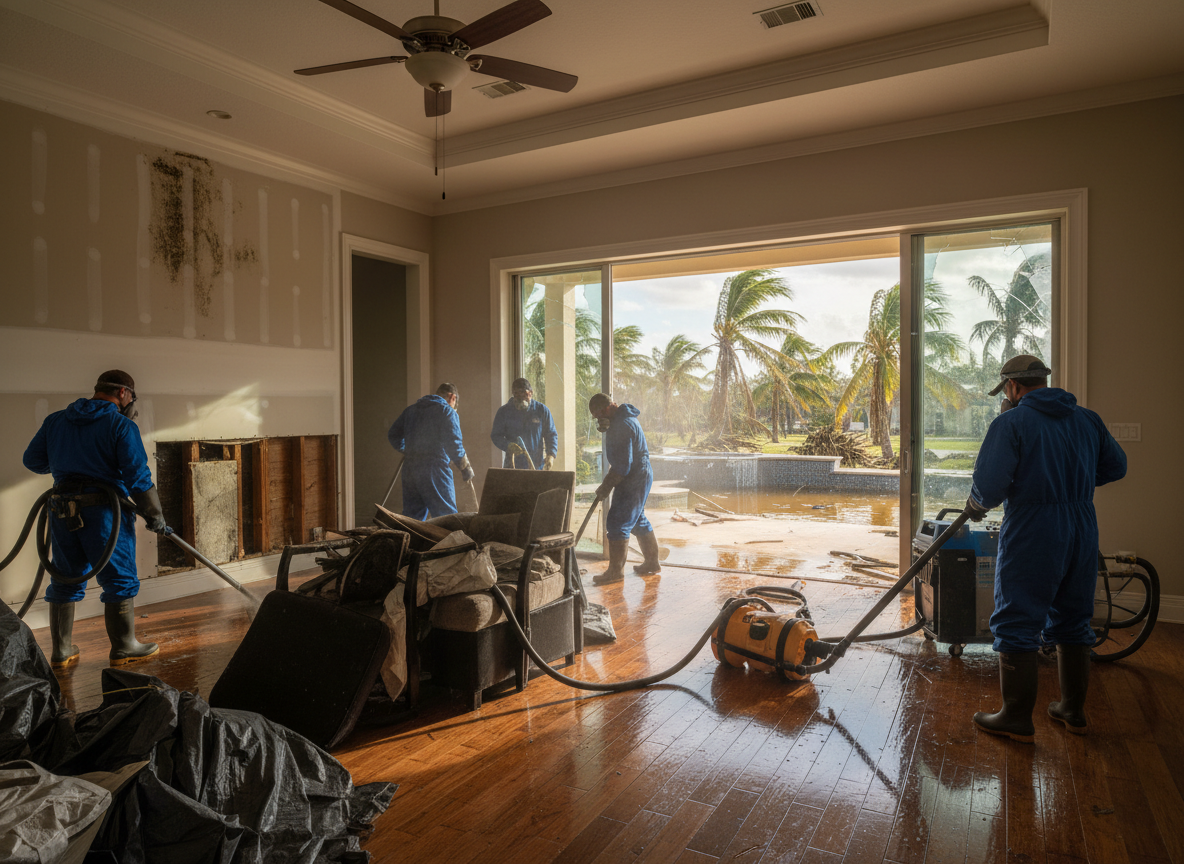
A storm does not have to be a named hurricane to put water inside a Boca Raton house. A summer squall with wind-driven rain against a sliding door, a barrel-tile roof that has lost its underlayment at one edge, or a stucco crack above a window is enough. Storm damage restoration starts with finding the entry point, because the stain on the ceiling is rarely directly under the failure and the wall that looks dry is often the one holding the water.
Why storm calls in Boca Raton are rarely just roof calls
After a storm, the obvious damage gets the attention: a missing tile, a torn screen, a branch on the lawn. The water damage is usually quieter and more expensive, and it is spread across several building components at once.
Wind and rain are separate events. Wind opens a joint, lifts an edge or cracks stucco. Rain then enters through the opening, sometimes hours later and sometimes on the next storm. A roof that looks intact from the ground can have a failed flashing at a valley or a ridge that only leaks under wind pressure.
Water travels before it shows. In a ceiling assembly, water follows a joist, a truss chord or a slab soffit. The stain appears at the low point, not at the entry. In a wall, water runs down the inside of the stucco and collects at the bottom plate. Finding the entry means reading the assembly, not just the stain.
Salt changes the cleaning. On the barrier island, storm water can carry salt and debris. Material soaked by surge or canal water is treated differently from material soaked by rain entering a roof. The category decides what can be saved.
The repair is usually someone else's. A roof, a window, a door and the building envelope belong to a roofer, a glazier or a general contractor. We dry the interior, document the entry and name the trade. Pretending otherwise is how a homeowner ends up with a dry ceiling and an open roof.
Why the first dry week after a storm matters most
A storm leaves the ground saturated, the canals full and the air heavy. In that week, a building that took water is at its most vulnerable, because the material cannot dry outward and the interior humidity stays high.
Boca Raton's geography makes this worse. The city sits on sandy coastal ground with a high water table, and the barrier island portion is only a few feet above sea level. After a storm, water in the ground has nowhere to go, and a wall base that would dry in a dry climate stays damp. The C-15 canal and the Intracoastal can remain high for days, which slows drainage in the lowest streets.
Hurricane season runs from 1 June to 30 November, and the storms that cause the most interior damage are often not the ones with the biggest names. A slow-moving tropical storm or a training squall line can drop more water on a roof than a hurricane that passes quickly. The damage is cumulative: the first leak wets the insulation, the second wets the ceiling, and by the third the cavity has been damp long enough for growth.
The cost of waiting is not only the restoration. A ceiling that could have been dried may need replacement. Insulation that was wet for a week has to come out. A window that was not sealed before the next band of rain turns a small interior repair into a larger one. The first dry week is the cheapest week.
What you can check before you book storm damage restoration
Boca Raton FL Mold Remediation works from 5461 N Dixie Hwy, Boca Raton, FL 33487, in Palm Beach County. The number is (561) 960-0937. The services are exactly four: mold remediation, water damage repair, water extraction and storm damage restoration, which includes water leak detection.
The area is Boca Raton and eight towns within about nine miles: Highland Beach, Delray Beach, Boca Del Mar, Deerfield Beach, Whisper Walk, Sandalfoot Cove, Mission Bay and Lighthouse Point. Deerfield Beach and Lighthouse Point are in Broward County; the other six are in Palm Beach County.
We do not publish a licence number, certifications, an insurance certificate, a founding year, staff biographies, project counts or reviews, because the business has not given us those facts to state. We do not decide insurance coverage and we do not act as a public adjuster. What we provide is a documented record of the entry point, the affected material and the readings, plus a clear statement of which repair belongs to another trade.
A barrier-island house after a king tide and a squall line
East of the Intracoastal, Boca Raton includes a strip of barrier island near the inlet, where the ocean, the inlet and the Intracoastal are all within a short distance. A house there can take three kinds of water in one night: rain driven against the windows, surge pushed up the canals, and groundwater rising through the soil.
The call usually comes the morning after. The owner has water in the garage, a damp patch at the base of a wall and a sliding door that will not latch. The rain has stopped, the sun is out, and it is tempting to assume the house will dry. On a barrier island after a king tide, the ground is still saturated and the wall base is still wicking.
The first task is to separate the sources. Water that entered at the door track is rain or surge; water that came up through the slab edge is groundwater; water on the ceiling is a roof or window opening above. Each has a different entry point and a different repair, and treating them as one loss hides the one that will still be active at the next high tide.
The second is salt and debris. Surge water leaves salt in the wall base and behind the baseboard, and salt holds moisture. Hard surfaces can be cleaned, but the cleaning has to be part of the scope. Carpet, pad and cabinet bases that took surge usually come out, and the documentation needs to say why.
The third is the envelope. A sliding door that no longer latches, a window that has lost its seal or a stucco crack at the head of an opening will let the next storm in. We document those conditions and hand them to a glazier, a door specialist or a stucco contractor. Drying the interior without closing the opening is a job that repeats.
Where storm water gets into a Boca Raton building
Four components account for most of the storm water we are called to. Each one fails in a way that is visible from the inside only after the water has travelled, and each needs the exterior repair named before the interior work can hold.
A barrel-tile roof at a valley or ridge
The component is the clay or concrete tile, the underlayment beneath it, the valley flashing and the ridge cap. Tile is a rain screen, not the waterproof layer; the underlayment does the work, and it ages in the sun. What you notice is a ceiling stain that appears after wind-driven rain, granules or tile fragments in the gutter, or a damp patch at the top of a wall. First move: photograph the stain and the roofline from the ground, keep weight off the ceiling and have the roof inspected by a roofer. The interior drying is ours; the roof repair is not.
A sliding door track or threshold
The component is the door track, the weep holes, the threshold pan and the seal between the frame and the stucco. Wind-driven rain reaches the track faster than the weep holes can drain it, and a track that is blocked or a pan that has corroded lets water into the wall base. What you notice is water on the floor at the door, a swollen baseboard beside it, or a stain on the ceiling of the room below a balcony. First move: clear the track, check that the weep holes are open and read the wall base inside before the next rain.
A stucco crack at a window head or corner
The component is the stucco skin, the control joint, the window flange and the sealant at the frame. Stucco is brittle and moves with the building; a hairline crack at a corner or a window head is enough for wind-driven rain. What you notice is a damp patch at the top corner of a window, paint blistering on the interior, or a smell in the room after a storm. First move: photograph the crack from outside if it is safe, check the interior with a meter and have the exterior sealed by a stucco or envelope contractor before the next storm.
Soffit, fascia and attic ventilation
The component is the soffit panel, the fascia board, the drip edge and the attic vents. Wind can lift a soffit panel or drive rain into an attic vent, and water then runs along the top plate and down a wall. What you notice is a stain at the top of a wall, insulation that is damp in one corner, or a musty smell in the attic. First move: do not enter the attic if the ceiling is sagging or the access is unsafe; photograph from below and have the roof edge inspected. Attic drying and insulation removal are part of our scope once the opening is closed.
The next step in Boca Raton
If a storm has left a stain, a damp wall or a door that no longer seals, call (561) 960-0937. Describe what the storm did, where the water appeared and whether the roof or a window is still open. We will tell you what can be dried now and which repair has to happen first.
How it works
- 1
Call and safety guidance
We ask what the storm did, where water is coming in and whether the roof or a window is still open.
- 2
Leak detection and boundary
We trace the entry point, read the ceiling and wall assembly and mark the wet boundary.
- 3
Emergency protection
Where an opening cannot be closed by another trade immediately, we protect the interior and contain the work area.
- 4
Extract, remove and dry
Water is extracted, unsalvageable material is removed and drying runs against recorded readings.
- 5
Document and hand off
We photograph the damage, record the source and name the roofing, glazing or building repair that remains.