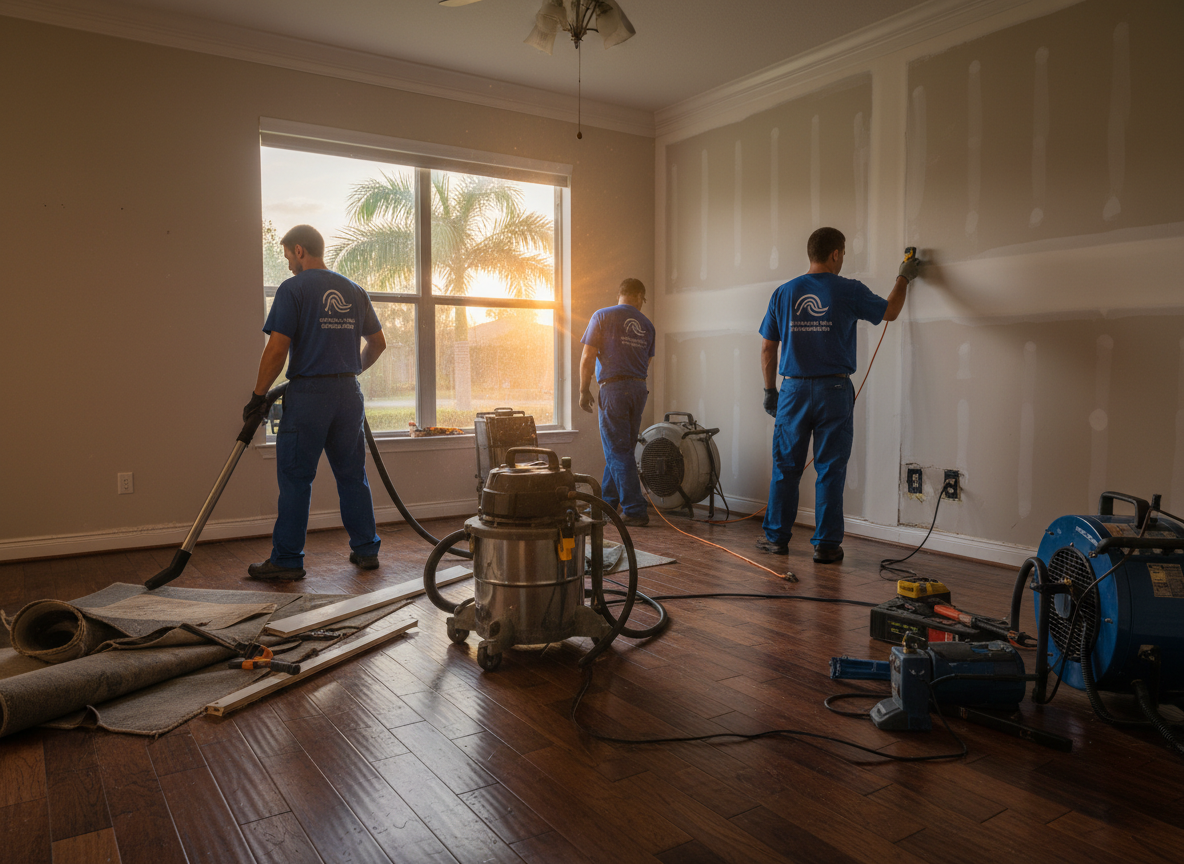
Water damage in a Boca Raton home rarely stays where it lands. A water heater in a hallway closet soaks the wall behind it and the ceiling below. A supply line under a kitchen island sends water across a tile floor and into the base of the next room. A slab leak can run for weeks under the floor before anyone sees a stain. Water damage repair starts with stopping the water and finding the boundary of what is wet, not with a fan and a promise.
Why Boca Raton homeowners call us for water damage repair
Most water calls are not emergencies by the time they reach us. They are the morning after: the leak is off, the floor is cold, and the homeowner is trying to work out whether the wall needs to come out. That is exactly the point at which a proper reading saves money.
We find the edge of the water. Water travels through the path of least resistance: under tile, along a joist, inside a wall base. A room can look dry and still have a saturated assembly behind it. Meters and thermal imaging tell us where the wet boundary actually is, and the boundary decides the scope.
We separate the emergency from the repair. Extraction and drying are one job. Replacing a failed pipe, a roof flashing or a window is another. The written scope says which is which, so you are not asked to approve a rebuild to get a room dried, and you are not left with a dry room and an open wall and no idea who closes it.
We dry to a number, not to a feeling. Material reaches a dry standard or it does not. Readings are taken at marked points and compared day by day. Equipment is adjusted when the numbers stall, rather than left running on the assumption that more air is better.
We document the loss in sequence. Photographs before, during and after, the water source, the affected rooms and the readings. That record is useful to an owner, a landlord, an association and an adjuster, and it is produced as the work happens rather than reconstructed afterwards.
How water removal and water extraction fit together
We treat water removal and water extraction as two named parts of water damage repair rather than two separate businesses. On a real job they run in sequence, often on the same visit, and the hand-off between them is where most problems are created or avoided.
Water Removal
Water removal is the first phase: stopping the source where that is possible and safe, then getting the bulk of the water out of the building before it spreads further. It is the phase that decides how much material survives, because water that is left in a room keeps wicking into wall bases, cabinet toe kicks and floor seams.
The steps we follow:
- Confirm the source and the water category before touching anything, because grey or contaminated water changes what can be saved.
- Photograph the affected rooms and record the water line before it is disturbed.
- Pump or vacuum standing water from the floor, including beneath furniture and inside cabinet bases.
- Remove saturated carpet, pad and any material that cannot be dried in place, bagging it out through a controlled route.
- Detail-extract the seams, wall bases and floor transitions that a pump cannot reach, then set drying equipment against marked readings.
What's included in water removal:
- Standing-water removal with portable or truck-mounted extraction equipment
- A water-category assessment before removal, explained to you in plain terms
- Removal and disposal of saturated pad, carpet and unsalvageable material
- Detail extraction at wall bases, cabinet toe kicks and floor seams
- Containment where contamination or visible growth is present
- Photographs and a written record of what was removed and why
Water Extraction
Water extraction is the part of the job that pulls water out of the materials themselves: carpet and pad, the gaps under hard flooring, the base of a cabinet and the bottom plate of a wall. It is more detailed and slower than pumping a floor, and it is the difference between a room that dries and a room that smells a week later. Water extraction also has its own page on this site because it is often booked as a standalone service after a small supply-line break.
The steps we follow:
- Read the floor and wall base at several points to establish how far the water has travelled.
- Use weighted extraction on carpet and pad where the material can be saved, working in overlapping passes.
- Pull baseboard or drill a small inspection opening only where the readings justify it, and explain the opening before cutting.
- Extract cabinet toe kicks and floor transitions by hand, where a machine head cannot reach.
- Re-read the same points, record the numbers and set the drying plan from what the meter shows.
What's included in water extraction:
- Weighted extraction of carpet and pad where the material can be saved
- Detail extraction at wall bases, cabinet toe kicks and floor seams
- Removal of pad or carpet that cannot be saved, bagged out of the building
- Small inspection openings where the wall base reading requires one
- Moisture readings at marked points before and after extraction
- A written drying plan that names the equipment and the points to be checked
Why a Boca Raton water problem cannot wait for the weekend
A water leak in South Florida is not a dry-climate leak. The house is closed, the air conditioning is running, and the indoor humidity is already high. Wet material does not dry on its own in that environment; it stays damp and feeds growth while the owner waits for a weekday appointment.
The building stock adds its own delays. Boca Raton has a high water table, which is why basements are not part of the construction vocabulary here. Water that gets under a slab has nowhere to drain and spreads laterally through the fill. Tile and thinset hold moisture against the slab. Cabinet bases and drywall wall bases sit close to the floor, where the water collects first and dries last.
Hurricane season, from 1 June to 30 November, makes the timing worse. A storm can fill the canals and the retention lakes, raise the water table and leave the ground saturated for days. A plumbing leak during that week is competing with the weather for somewhere for the water to go. The same is true in the western communities, where flat ground and full lakes slow every drainage path.
There is also a less obvious cost: a small leak that is dried in the first day or two is usually a drying job. The same leak left for a week is often a removal and rebuild job, with cabinets, baseboards and a section of wall added to the scope. Waiting does not reduce the work. It moves it from the drying column to the demolition column.
What you can check before you book water damage repair
The business is Boca Raton FL Mold Remediation at 5461 N Dixie Hwy, Boca Raton, FL 33487, in Palm Beach County. The number is (561) 960-0937. The services are exactly four: mold remediation, water damage repair (which includes water removal and water extraction), water extraction as a standalone service, and storm damage restoration.
The area is Boca Raton plus eight towns within about nine miles: Highland Beach, Delray Beach, Boca Del Mar, Deerfield Beach, Whisper Walk, Sandalfoot Cove, Mission Bay and Lighthouse Point. Deerfield Beach and Lighthouse Point are in Broward County; the rest are in Palm Beach County.
We do not publish a licence number, certifications, an insurance certificate, a founding year, staff biographies or reviews, because the business has not given us those facts to state. We will not tell you a wall is dry because it feels dry, and we will not present a moisture meter as a guarantee. What we can show you is the reading, the photograph and the written scope.
A canal-front house when the C-15 canal is already full
The C-15 canal runs along Boca Raton's northern boundary, connecting the El Rio Canal to the Intracoastal Waterway. Houses on the canals that feed it have a specific water problem that inland homeowners do not: when a summer storm drops several inches in an hour, the canal is already carrying stormwater from the city, and the yard has nowhere to send its own.
A call from one of these houses usually follows the same pattern. The owner has watched the water come up the lawn, across the pool deck and to the base of the rear wall. It recedes when the rain stops, so it feels like a near miss. A week later the baseboard on the rear wall is swollen and the room smells musty. The water did not need to enter through a door; it entered through the wall base, the weep holes and the slab edge, and it stayed in the assembly after the yard drained.
The first thing we do is separate the two water sources. Rain that entered at the wall base is one boundary; water that came through a failed door seal or a pool-deck drain is another. They need different drying and different repairs, and mixing them in one scope hides the entry point. We read the interior wall base, the door track and the slab edge, and we photograph the exterior water line while it is still visible.
The second is the salt question. Canal water and storm surge are not clean water, and material that has been soaked in them is treated differently from material soaked by a supply line. Carpet, pad and cabinet bases that have taken canal water usually come out. Hard surfaces can be cleaned and dried, but the cleaning is part of the scope, not an afterthought.
The third is drainage. Drying the inside of a canal-front house while the yard still holds water against the wall is a temporary result. We tell you what we found at the exterior, and if the fix is a French drain, a regraded pool deck or a repaired seawall, that belongs to a landscape or marine contractor. Naming it is part of an honest hand-back.
Where water damage in Boca Raton usually starts
Four components account for most of the water we are called to. Each fails in a way that is easy to miss, and each one needs the source corrected before drying can hold.
A braided supply line or angle stop under a sink
The component is the flexible braided line, the compression fitting and the angle stop that feeds a sink, a toilet or a washing machine. Rubber and braided lines have a service life, and the fitting behind a cabinet is rarely looked at until it fails. What you notice is water on the cabinet floor, a swollen toe kick, a musty smell under the sink or a stain on the ceiling below. First move: close the angle stop, place a towel and a bucket, and do not tighten a leaking compression nut that has already failed. The repair belongs to a plumber; the drying and the cabinet base belong to us.
A water heater in a closet or on a platform
The component is the tank, the pressure relief valve, the drain pan and the pan drain line. A tank can weep from the bottom for weeks before it lets go, and a pan drain that is blocked or was never connected turns a small leak into a closet floor and a ceiling below. What you notice is rust at the tank base, water in the pan, a warm damp smell in the closet or a stain on the ceiling under the platform. First move: shut off the power or gas and the cold inlet, then read the closet floor and the wall behind the tank. Replacing the heater does not dry the assembly around it.
A slab leak under tile or laminate
The component is the supply or drain line embedded under the slab, and the tile, thinset or underlayment above it. Copper and older pipe can develop a pinhole, and the water has nowhere to go except sideways through the fill and up into the flooring. What you notice is a warm spot on the floor, a water bill that climbs, a baseboard that swells in one room, or a faint sound of running water when nothing is on. First move: confirm with the water meter and call a plumber for the pipe. The floor and the wall base still need to be read, because the leak can travel further than the wet tile suggests.
A washing-machine box or laundry drain
The component is the supply hoses, the recessed laundry box, the standpipe and the drain connection behind the machine. Hoses burst under pressure, boxes crack, and a standpipe that is partially blocked overflows on the rinse cycle. What you notice is water behind the machine, a soft patch in the laundry floor, a smell in the hallway or a stain on the ceiling below. First move: turn off both supply valves, move the machine forward only if it is safe, and read the wall and floor behind it. The hose and valve repair is a plumber's work; the wet assembly is ours.
The next step in Boca Raton
If water has reached a wall, a ceiling or a cabinet base, call (561) 960-0937. Tell us where the water came from, how long it has been there and what has already been shut off. We will tell you what the visit involves and whether the next call should be to us or to a plumber first.
How it works
- 1
Stop the water and make the room safe
We confirm the source, isolate the area and identify electrical or structural hazards before equipment goes in.
- 2
Read the moisture boundary
Meters and thermal imaging mark what is wet, including wall bases and cavities that look dry from the surface.
- 3
Remove standing water and saturated material
Extraction comes first, then removal of carpet, pad and material that cannot reach a dry standard.
- 4
Dry against recorded readings
Air movers, dehumidifiers and cavity drying run at marked points, adjusted each day rather than left to guesswork.
- 5
Verify and hand back the repair list
We compare final readings with day one and list what remains for a plumber, a roofer or a general contractor.