2026-10-22 ·
Why Boca Raton Homes Stay Damp After the Rain Stops
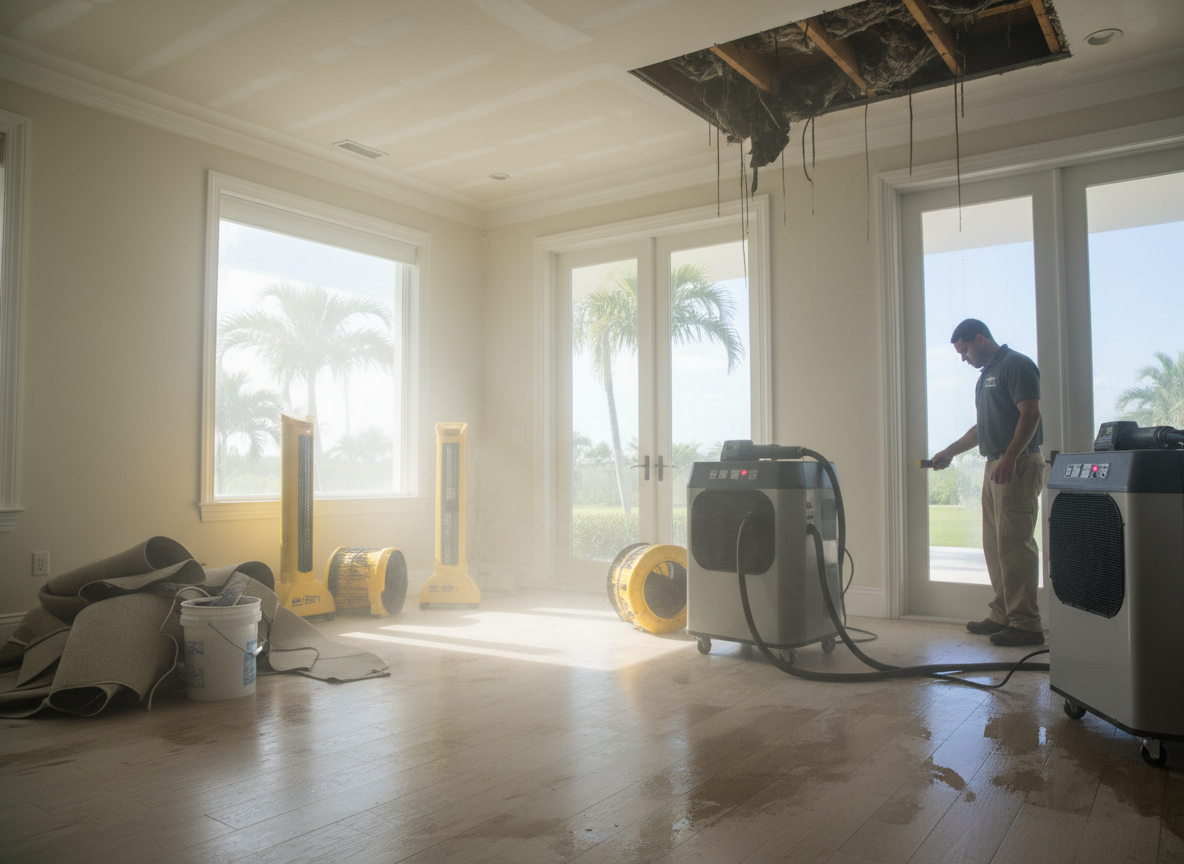
A Boca Raton house can be dry to the touch on Sunday and still be wet inside the wall on Friday. The rain has stopped, the street has drained and the ceiling looks the same, but the meter says otherwise. That gap between how a house looks and how it reads is the reason water damage here so often turns into a mold job.
The explanation is not mysterious. It comes down to where the water came from, how long it stayed and what the building does with it afterward.
Three sources that behave differently
Water reaches a Boca Raton building from three directions, and they are easy to confuse at the wall base. The first is the canal and stormwater system. Lake Boca, the C-15 canal and the smaller waterways that cross the city rise during heavy rain, and the flat ground has nowhere to put the surplus. Water can come up through a lawn, a driveway or a garage slab rather than through a door.
The second is rain driven through the envelope: a roof detail, a window frame, a door track or the seam where an addition meets the original wall. This water usually appears high and travels down inside the assembly before it stains a ceiling or a floor.
The third is plumbing. A supply line, a drain, a water heater pan or a condensate line can run for weeks without being seen. In a city with a lot of housing from the 1950s through the 1990s, the original parts are at the age where failures are ordinary.
Why the ground stays wet
Boca Raton sits low, and the water table is close to the surface in many neighborhoods. When the canals are high, the soil cannot drain, and a wall base that looks fine can be sitting against saturated ground for days. That is why drying a room without looking at the exterior can fail: the interior dries, the ground keeps feeding the wall, and the reading climbs again after the equipment leaves.
On the barrier island the same problem has a salt dimension. Salt air works on stucco, paint and metal, and a wall that stays damp near the coast deteriorates faster than the same wall inland. It also leaves a residue that holds moisture after the visible water is gone.
What older housing does with water
A 1950s or 1960s house in Boca Raton is often concrete block with stucco, a terrazzo or tile floor and furred walls. Water that gets behind the furring has a narrow space to sit in, and the block holds it. A 1970s villa may share a wall with a neighbour, so a leak on one side can wet both. A 1990s two-storey house puts a bathroom or a laundry over a ceiling, and the ceiling assembly gives a small leak somewhere to travel before it shows.
In every case the age of the building changes the repair, not just the drying. A wall that has been wet for a week in a 60-year-old house is a different conversation from a wall that has been wet for a day in a new one.
What to check after the rain stops
Start at the exterior. Look at the wall base beside the doors, the pool deck and the driveway, and note how high the canal came. Inside, check the cabinet toe kicks in the kitchen and bathrooms, the ceiling below any upstairs bathroom or air handler, and the closet that backs onto an exterior wall. A musty smell in a closed room is evidence even when nothing looks wet.
Photograph what you find before you move anything. If a ceiling is sagging or water is near an outlet or a panel, keep the room clear and turn off the circuit at the breaker. Do not run a household vacuum in standing water.
When a damp wall becomes a mold job
Mold needs moisture, and it does not need a flood. A wall that has stayed damp for a few days is enough in this climate. The sign is usually a musty smell, a discoloured patch at a baseboard or a closet that never seems to dry. At that point the work is no longer only about removing water; it is about containing the area, removing material that cannot be cleaned and correcting the source.
The source is the part that gets skipped. Cleaning growth while a supply line still weeps or a door track still lets water in buys a few months and then repeats the job. That is why the first visit should end with a written scope that names the source, the affected material and the trade that owns the permanent repair.
If you are not sure whether the problem is a wet wall or a plumbing failure, describe it on the phone. The answer usually becomes clear from where the water appeared first and what is below it.
Call (561) 960-0937 and describe what you found. We work from 5461 N Dixie Hwy in Boca Raton and cover the city and eight nearby communities in Palm Beach and Broward County.