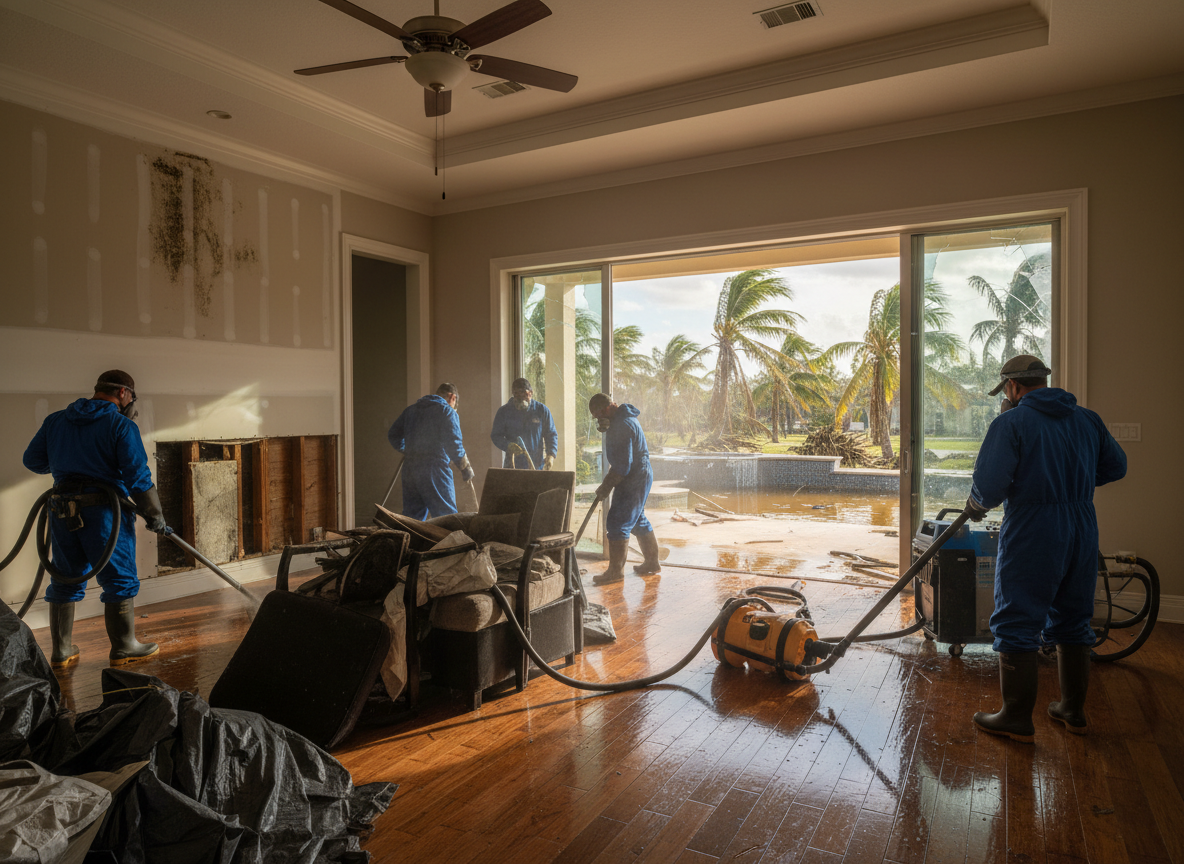
Mission Bay was built around water. The community's ten villages sit among lakes and lagoons on just over 500 acres west of US 441, and many of its homes were sold on a lake view. That view is also a drainage system. When a summer storm fills the lakes faster than the outfalls can take the water, a lake-front lanai and the wall base behind it can be wet before the owner realizes the rain has stopped.
What should a Mission Bay homeowner know first?
Mission Bay is a master-planned community of 1,239 homes in ten villages, started in 1986 on just over 500 acres west of US 441. It is unincorporated Palm Beach County with a Boca Raton mailing address, several villages are gated, and most of the housing was built between 1986 and 1995.
A community organised around villages and water
The community began in 1986 and was built out over roughly a decade, with single-family houses, townhomes and villas arranged in villages such as Laguna, Las Flores, Reflections, Regatta, Sonata, Ventura and The Isles. The master association maintains the shared clubhouse, roads and common areas, while each village has its own sub-association, budget and rules. The lakes and lagoons are both amenity and drainage, and a lot that fronts on water drains toward it. That is the first thing to understand about a water loss here: the exterior water level and the interior moisture are connected.
Housing from the late 1980s and early 1990s
The homes are mostly two-storey single-family houses, with townhomes and villas in some villages, built with concrete block, stucco and tile roofs. Living areas run from about 1,500 to over 3,300 square feet. At thirty to forty years old, the original water heaters, supply lines and roof details are at the age where failures are routine. Impact windows and roof replacements have been done in some homes and not others, so two houses on the same street can have very different envelopes.
Lakes, lagoons and flat ground
The community is flat, and its lakes are part of the stormwater system rather than isolated ponds. During heavy rain, the lakes rise while water is still arriving from the streets and the roofs, and the outfalls can only move so much. A lake-front lanai, pool deck or wall base can take water even when the roof is sound. The water table is high, so the ground cannot absorb what the lakes cannot take.
Who serves a Mission Bay address
Mission Bay is not inside the City of Boca Raton. Palm Beach County handles zoning, building permits and most services, and the property appraiser record confirms the jurisdiction for a parcel. The master association and the village board control access, work hours and exterior changes, and gated villages add another layer. Water and sewer service is provided by a utility, and your bill identifies it.
What does a Mission Bay property need?
The community's housing is old enough that a water call is usually about a component rather than a storm. A two-storey house needs the ceiling below the upstairs bathroom read, a lake-front home needs the lanai and wall base checked after heavy rain, and a gated village needs access planned before the crew arrives.
- Water damage repair covers drying and the repairs inside our scope after a supply line, water heater or appliance failure.
- Water extraction is the first step when water is visible or has soaked carpet, pad or a cabinet base.
- Mold remediation applies where a wall or ceiling has stayed damp long enough for growth, which is common in homes that sit empty.
- Storm damage restoration covers wind and rain intrusion at roofs, windows and doors, with leak detection to find the entry point.
In a gated village, we document the unit boundary and share the record with the owner and the village board.
Why choose Boca Raton FL Mold Remediation in Mission Bay?
Our base on N Dixie Hwy is about 8 miles from Mission Bay, and we work in the two-storey houses, townhomes and villas that make up the community. We plan gate access and containment with the manager, read moisture before removal and write the scope before work starts. We are clear about what we do not do: the roof, the plumbing repair and the rebuild belong to other trades. This site does not publish licence numbers, certifications or reviews.
Why Mission Bay water damage gets worse quickly
A house built in the late 1980s or early 1990s has had time for several small repairs and not necessarily a full replacement of the parts that fail quietly. Supply lines above a ceiling, angle stops under a vanity and the pan drain under a water heater are easy to ignore until they let go. A two-storey house adds a ceiling assembly between the leak and the room below, so the water can travel before it shows.
The lakes add a second pressure. During a heavy storm, the water level in the community rises while the rain is still falling, and a lake-front lanai or wall base can take water even if the roof is sound. The flat ground and high water table mean the water has nowhere to go quickly. After the storm, the humidity stays high around the lakes, and a damp wall takes longer to dry.
Hurricane season runs from 1 June to 30 November, and the ordinary summer storm is the more frequent cause of interior damage. In a climate where a damp surface can support growth in about a day or two, the difference between a small drying job and a wall removal is often how long the leak ran before anyone noticed.
Where water hides in a Mission Bay home
In a two-storey house, the first place to read is the ceiling below the upstairs bathroom, laundry or air handler. Water from a supply line or a tub overflow can run along a joist before it stains, so the patch is rarely directly under the fixture. The second is the wall base beside the lanai and the sliding doors, where wind-driven rain and lake water arrive. The third is the cabinet toe kick in the kitchen and bathrooms, where a slow leak collects out of sight.
In a villa or townhome, the shared wall is the first place to read, because water travels sideways as well as down. In a gated village, access and the material route have to be planned before the visit. We read all of those points before we remove anything, and we document the boundary so the owner and the village board are looking at the same evidence.
How a Mission Bay job runs, step by step
- We take the call and ask what is wet, where it came from, whether the home is occupied and which village it is in.
- We arrange gate access with the owner or manager, then read the affected rooms and the assembly around them with meters and thermal imaging.
- We contain the work area, protect contents and set HEPA filtration where growth is being disturbed.
- We extract standing water, remove material that cannot be dried and set drying equipment against marked readings.
- We compare final readings with day one, walk the rooms with you and leave a written record and a repair list.
What's included in a Mission Bay job
- A moisture assessment of the affected rooms and the assembly around them
- Thermal imaging where the leak is concealed above a ceiling or inside a wall
- Containment with sealed openings and protected contents
- Extraction of standing water and removal of saturated pad, carpet or drywall
- Drying equipment set at marked points, monitored and adjusted
- Photographs before, during and after the work
- A written scope separating our work from a plumber's, roofer's or general contractor's
We also note the condition of the component that failed, because a late-1980s supply line that has failed once is likely to fail again somewhere else in the same run.
What should a Mission Bay homeowner check before the next storm?
Check the water heater pan and its drain, the supply lines above the ceiling and the angle stops under every sink. Clear the lanai and patio door tracks, and look at the wall base beside them after heavy rain. If the home will be empty for the season, shut off the water at the main if the village allows it and leave the air conditioning on a dehumidifying setting. Photograph the interior while it is dry.
What a Mission Bay water call looks like in practice
The most common call is a two-storey house with a stain on the ceiling below an upstairs bathroom. The supply line behind the vanity has failed, the ceiling board is damp and the insulation above it is wet. We shut off the water, read the ceiling and the wall, remove the saturated board and dry the joists before the plumber repairs the line.
The second is a lake-front home after a storm, with water at the lanai and the wall base. The roof is sound, but the lake has risen and the wind-driven rain has reached the door track. We separate the two sources, dry the interior and name the exterior drainage or door repair.
The third is a gated village where access has to be arranged before the crew can start. We plan the gate, parking and material route with the manager, then read the unit and document the boundary for the board. In each case, the sequence is the same: find the water, stop it, read the boundary, then decide what can be saved.
Nearby areas we also serve
Mission Bay is at the western edge of the Boca Raton area, and the communities around it are close:
What's the next step in Mission Bay?
Call (561) 960-0937 and describe the home, the water source and which village it is in. Tell us who manages the gate so we can arrange access. We will explain what the visit involves and what can be scoped from the description before anyone books a time.
If the home will be empty for the season, say so when you call. A shut-off at the main and a dehumidifying setting on the air conditioning reduce the chance that a small leak runs for weeks, and a neighbour or the village manager can check the unit after a storm. We can note those arrangements in the written scope.
Around Mission Bay
We regularly work near:
- 📍Mission Bay Clubhouse
- 📍Glades Road
- 📍US 441 (State Road 7)
- 📍Palmetto Park Road
- 📍Mission Bay Community Park
Mold Remediation in Mission Bay — Local Notes
- •Mission Bay is unincorporated Palm Beach County, not the City of Boca Raton.
- •The community has ten villages, and some are gated.
- •The lakes and lagoons are part of the stormwater system and rise during heavy rain.
- •The master association and each village board control access and work hours.